
Medium Duty Double Shaft Shredder
Medium duty is our main category for regular industrial processing: RDF, electronic waste, plastic waste, municipal solid waste and industrial scrap.
Category introduction
The Medium Duty range is the main category for regular industrial waste processing. It covers RDF preparation, electronic waste, plastic waste, municipal solid waste, industrial scrap and the general run of daily processing work where the shredder is part of the routine rather than an occasional tool.
Recycling units, waste handling yards, RDF lines and manufacturing sites with a steady internal waste stream sit here. This range gives real margin for pieces that arrive larger than expected and for disclosed incidental contamination, without being engineered for the sustained bulky-feed work that the heavy-duty range is built around.
Most enquiries that begin with light duty in mind end up here once the actual daily volume and feed variation are described.
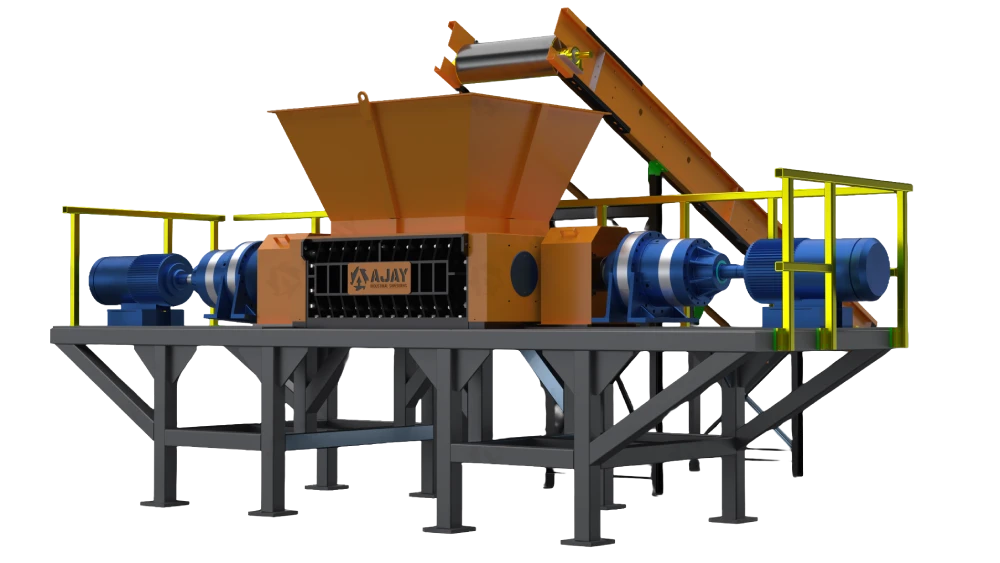
Medium Duty Models
Every throughput figure below is indicative. Final specifications follow application review and approved technical drawings.
|
Model |
Stage |
Motor |
Total HP |
Indicative throughput |
Typical application |
Shaft speed |
|---|---|---|---|---|---|---|
|
AIS-DS-20-H40-P |
Primary |
20 HP × 2 |
40 |
1–2 t/h |
Municipal waste |
25 RPM |
|
AIS-DS-20-H40-S |
Secondary |
20 HP × 2 |
40 |
0.8–1.5 t/h |
RDF and uniform chips |
30 RPM |
|
AIS-DS-50-H100-P |
Primary |
50 HP × 2 |
100 |
3–4 t/h |
Industrial scrap, textiles and MSW |
28 RPM |
|
AIS-DS-50-H100-S |
Secondary |
50 HP × 2 |
100 |
2–3.5 t/h |
Packaging and plastics |
30 RPM |
|
AIS-DS-75-H150-P |
Primary |
75 HP × 2 |
150 |
6–7 t/h |
MSW and RDF |
28 RPM |
|
AIS-DS-75-H150-S |
Secondary |
75 HP × 2 |
150 |
7–8 t/h |
MSW and RDF |
28 RPM |
Capacities are indicative and depend on material composition, density, moisture, contamination, input size, cutter configuration, feeding consistency and operating conditions. Final specifications are confirmed after application review, trial-material or site assessment where required, and approved technical drawings.
Suitable Waste Material Types
Materials commonly configured for the medium duty range, subject to application review.
RDF preparation
Regular preparation of refuse derived fuel from dry mixed waste, based on the composition received.
Electronic waste
Assemblies and housings ahead of separation, subject to removal of batteries and hazardous components.
Plastic waste
Rigid parts, containers, crates, packaging and purge in mixed form.
Municipal solid waste
Bulk reduction at collection and transfer points, subject to what the stream contains.
Industrial scrap and textiles
Mixed production waste and textile streams in regular daily volumes.
Typical Application Conditions
Sites that suit the medium duty range usually share several of these characteristics.
Configuration Considerations
Describe the variation, not the average
The largest and hardest pieces the machine will see matter more for configuration than the typical piece.
Primary or secondary stage
Primary machines open and reduce incoming material. Secondary machines refine it to a tighter output. Many lines run both, and the model table shows which is which.
Feed rate and consistency
A conveyor that feeds steadily changes the configuration compared with a grab that drops a large batch at once.
Running hours
Two shifts a day places a different demand on the machine than four hours a day, even at the same total volume.
Layout and access
Discharge height, downstream equipment position and maintenance clearance are settled in the technical drawing before fabrication starts.
Wear planning
Abrasive streams such as FRP or contaminated MSW affect cutter life. We plan inspection and service access into the build.
Why the Application Review Comes First
Medium duty covers a broad band of work, which is exactly why the review matters. Two sites can both describe their requirement as medium duty and need noticeably different configurations once the feed and the running pattern are examined.
We would rather spend that time before the drawing is approved than have a machine underperform against expectations that were never stated. Final configuration follows technical assessment.
Mixed waste may contain incidental contaminants, but their type, size and frequency must be disclosed during selection. Oversized metal, stone and prohibited foreign objects should be removed before feeding unless explicitly approved for the agreed machine configuration.
Related Waste Applications
Other Equipment Categories
Discuss Your Shredding Requirement
Tell us what you need to reduce and how the material reaches the machine. We will engineer the configuration around it.


